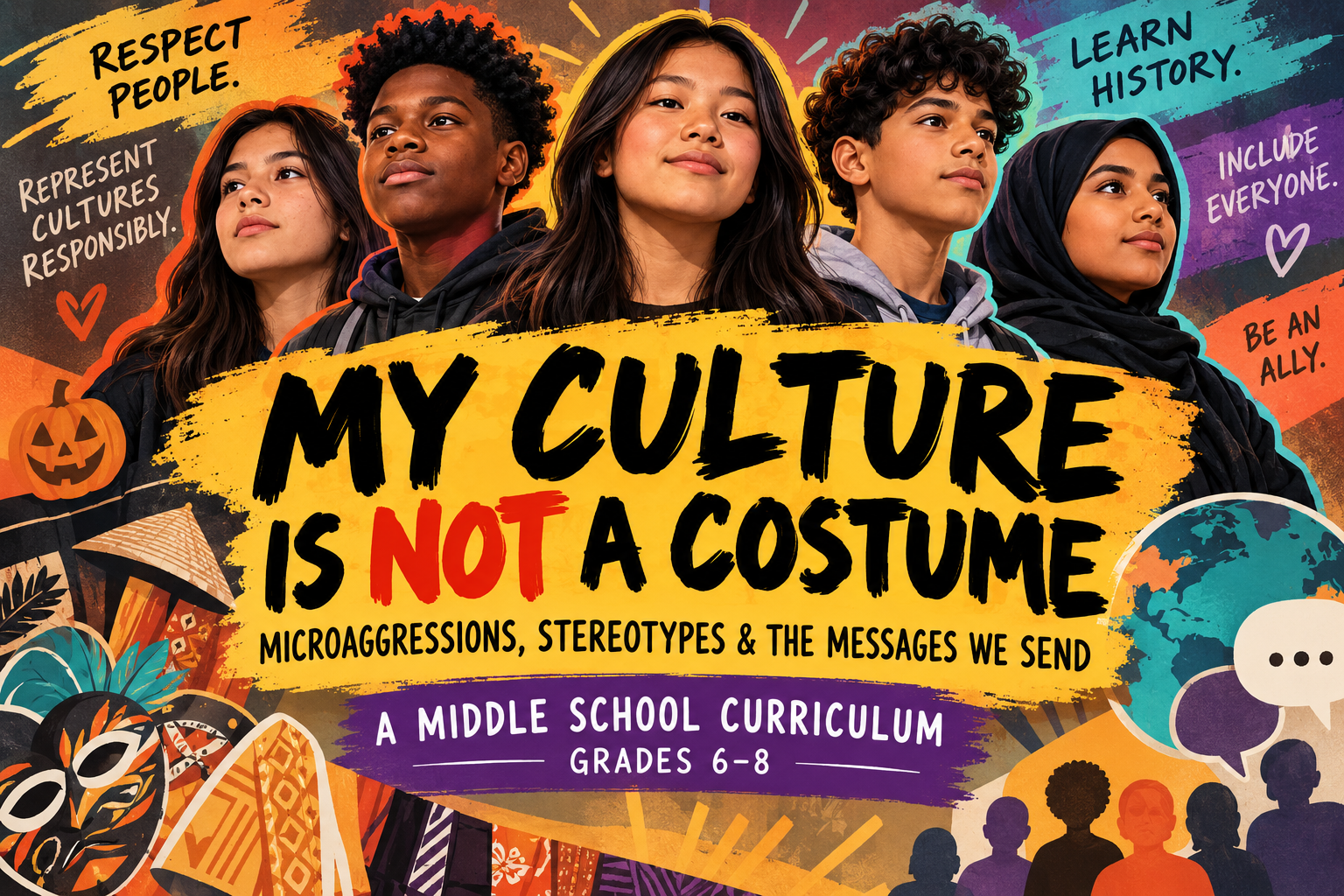
My Culture is NOT A Costume

Categories: Ethnic Studies
Wishlist Share

About Course

My Culture Is Not a Costume

Microaggressions, Stereotypes & the Messages We Send

Course Description | Middle School | Grades 6–8

Halloween is a time for creativity, costumes, and self-expression—but what happens when someone else’s culture becomes the costume?

My Culture Is Not a Costume is an engaging, thought-provoking middle school course that challenges students to think critically about cultural identity, representation, stereotypes, and the messages we communicate through our words, actions, and appearances.

Using Halloween as a starting point, students will explore the differences between cultural appreciation and cultural appropriation, examine the history behind harmful costumes and caricatures, and investigate how everyday microaggressions can reinforce stereotypes, even when no harm is intended.

Through real-world examples, age-appropriate historical investigations, media analysis, classroom discussions, and creative activities, students will learn to recognize subtle forms of bias, distinguish between intent and impact, and understand why cultural identity deserves respect rather than imitation or ridicule.

Students will also explore how humor, popular culture, social media, and fashion influence perceptions of race, ethnicity, religion, and belonging.

This course is not about taking the fun out of Halloween. It is about helping students recognize that creativity does not require turning someone’s identity into entertainment, and respect does not limit self-expression.

By the end of the course, students will be equipped to question stereotypes, recognize microaggressions, engage in respectful conversations across differences, and make thoughtful choices about how they represent themselves and others.

Essential Question: What messages do we send when we turn someone’s culture, identity, or lived experience into a costume, character, or joke?

Show More

What Will You Learn?

  • By the conclusion of My Culture Is Not a Costume, students will understand that cultural awareness is about more than avoiding offensive Halloween costumes. It is about recognizing the messages embedded in everyday interactions, questioning assumptions, understanding historical context, and treating people's identities and lived experiences with dignity.

Course Content

Who Am I Beyond What You See?
Identity, Culture and Belonging Who are you beyond what people see on the outside? In this introductory lesson, students explore the many layers of identity, including race, ethnicity, culture, family traditions, language, personal interests, and lived experiences. Through self-reflection and interactive activities, students investigate how identities are formed, how assumptions influence the way we see others, and why no one should be reduced to a single characteristic. Students will begin to understand the relationship between identity, belonging, and respect. Essential Question: How do the assumptions we make about others influence the way we treat them?

My Culture Is Not a Costume
Cultural Appreciation vs. Cultural Appropriation Can you celebrate another culture without disrespecting it? This lesson challenges students to examine the difference between appreciating a culture and appropriating its traditions, clothing, symbols, or identity. Using Halloween costumes, fashion trends, sports mascots, and popular culture as examples, students investigate how cultural practices can lose their meaning when removed from their original context. Students will consider questions of history, power, respect, and representation while exploring ways to celebrate cultural diversity without turning someone's identity into entertainment. Essential Question: When does cultural appreciation cross the line into cultural appropriation?

It’s Just a Joke… Or Is It?
Microaggressions & Hidden Messages Have you ever heard someone say, "You're pretty for a Black girl," "Where are you really from?" or "You don't act like other people from your culture"? These statements may seem harmless to the person saying them, but they can communicate powerful messages about belonging, intelligence, appearance, and identity. In this lesson, students learn to identify microaggressions, recognize the stereotypes hidden within everyday comments and jokes, and examine how repeated experiences of subtle bias can affect individuals and communities. Students will analyze real-world scenarios and consider why something does not have to be intentionally hurtful to cause harm. Essential Question: What messages can our words communicate, even when we don't intend to hurt someone?

When Costumes Carry History
Blackface, Stereotypes & Historical Context Why are some costumes more than just costumes? This lesson takes students beyond Halloween to investigate the historical origins of blackface, racial caricatures, stereotypical portrayals of Indigenous peoples, and other forms of cultural misrepresentation. Students examine how entertainment, advertising, theater, and popular media have historically reinforced harmful ideas about racial and cultural groups. Through age-appropriate historical examples, students will explore how these portrayals shaped public perceptions and why understanding history matters when making choices today. Essential Question: How can something presented as entertainment reinforce harmful ideas about an entire group of people?

Who Gets To Wear What?
Cosplay, Cultural Exchange & Respectful Representation Is dressing as a fictional character the same as dressing as someone's race or culture? In this lesson, students explore the sometimes complicated relationship between costumes, cosplay, cultural exchange, and identity. Using examples from anime, movies, video games, music, and Halloween, students investigate the difference between portraying a character and imitating racial or cultural characteristics. Students will discuss how creativity, context, stereotypes, and cultural significance influence whether a costume is respectful. The goal is not to establish a list of forbidden characters but to encourage thoughtful, informed choices. Essential Question: How can we celebrate characters, cultures, and creative influences without reducing people to stereotypes?

What Did You Really Say?
Intent, Impact & the Messages People Receive "But that's not what I meant!" In this lesson, students examine the difference between what someone intends to communicate and how their words or actions are experienced by others. Through everyday scenarios involving compliments, jokes, stereotypes, social media posts, and classroom interactions, students will identify the assumptions and hidden messages that can accompany seemingly innocent statements. They will also practice listening without becoming defensive, acknowledging harm, offering meaningful apologies, and communicating with greater cultural awareness. Essential Question: Why does the impact of our words matter, even when our intentions are good?

Say Something, Change Something
Responding to Harm & Becoming an Upstander What should you do when you witness someone being mocked, stereotyped, or excluded because of their identity? This lesson empowers students to move from recognizing bias to responding constructively. Students examine the difference between being a bystander and an upstander, practice age-appropriate strategies for addressing microaggressions, and learn how to support peers without escalating conflict. Through role-playing, discussion, and problem-solving activities, students develop the confidence to challenge harmful behavior, ask thoughtful questions, and help create more inclusive environments. Essential Question: How can we respond to disrespect in ways that promote accountability, dignity, and change?

More Than a Costume
Student-Led Awareness Campaign What would you want other students to understand about culture, identity, and respect? In this culminating lesson, students become educators and advocates by developing an original awareness campaign inspired by the course. Students may create posters, public service announcements, short videos, social media graphics, spoken-word performances, or informational materials that challenge stereotypes and promote respectful cultural representation. Using what they have learned about identity, appropriation, microaggressions, historical context, and communication, students will craft messages that encourage their peers to think beyond appearances and recognize the humanity behind every culture. Essential Question: How can we use our creativity and voices to challenge stereotypes and change the messages our communities receive?

Course-Wide Learning Outcomes
By the conclusion of My Culture Is Not a Costume, students will understand that cultural awareness is about more than avoiding offensive Halloween costumes. It is about recognizing the messages embedded in everyday interactions, questioning assumptions, understanding historical context, and treating people's identities and lived experiences with dignity. Final Reflection: Before you wear it, say it, share it, or laugh at it—consider the message it sends.

Student Ratings & Reviews

No Review Yet
No Review Yet